


Put simply — a PBN is a group of websites you control, all built to do one thing: send link equity to a site you're trying to rank. Google reads those links as third-party endorsements and moves the target site up in search.
Every backlink is a signal to Google about your resource's authority. The algorithm evaluates those links by quality and the naturalness of the link profile — but PBN networks are engineered specifically to manipulate rankings by artificially inflating SEO weight.
PBN SEO is not a new tool. It has existed for over 15 years and has survived dozens of Google algorithm updates. In 2026 it still works — but demands significantly deeper expertise than it used to.
What Defines a Private Blog Network (PBN)
Not all website networks are PBNs. The line between a PBN and a legitimate multi-site setup comes down to three things: single ownership, multiple domains, and a deliberate effort to keep that connection invisible.
| Element | Definition |
|---|---|
| Control | All link placement decisions — timing, placement, anchor selection — run through a single hand |
| Intent | The network exists to rank money sites — not to build real audiences or brands |
| Hidden ownership | WHOIS privacy, fake author personas, generic "About" pages, no real contact details |
Common Traits of PBN Sites
How they're built:
- Expired domains bought for their existing authority and link history
- Dropped domains repurposed for brand, slot, and other casino cluster targeting
- Free Web 2.0 platforms used as cheap satellites
What the content looks like:
- Short posts, often spun or AI-generated, with no real depth
- No original images, no identifiable author behind the byline
- Zero engagement — no comments, no shares, no return visitors
How the links behave:
- Outgoing links mostly concentrated on a small cluster of money sites
- Anchor text heavily skewed toward exact-match commercial keywords
- Sites within the network link to each other in patterns that don't reflect real editorial behavior
Legitimate Multi-Site Operations vs. PBNs
| Aspect | Legitimate Network | PBN |
|---|---|---|
| Ownership | Transparent, public | Hidden behind privacy layers |
| Purpose | User value, brand reach | Push rankings on target domains |
| Content | Genuinely useful | Thin, often generated |
| Link patterns | Contextual, varied, natural | Commercial anchors, concentrated targets |
| E-E-A-T signals | Demonstrable | Absent or faked |
How a PBN Network Works
The whole scheme rests on how Google decides who to trust. It trusts the sites that other authoritative sites link to. The more such "votes" your resource receives — the better it ranks. A PBN lets you get those votes without waiting, by organizing them yourself.
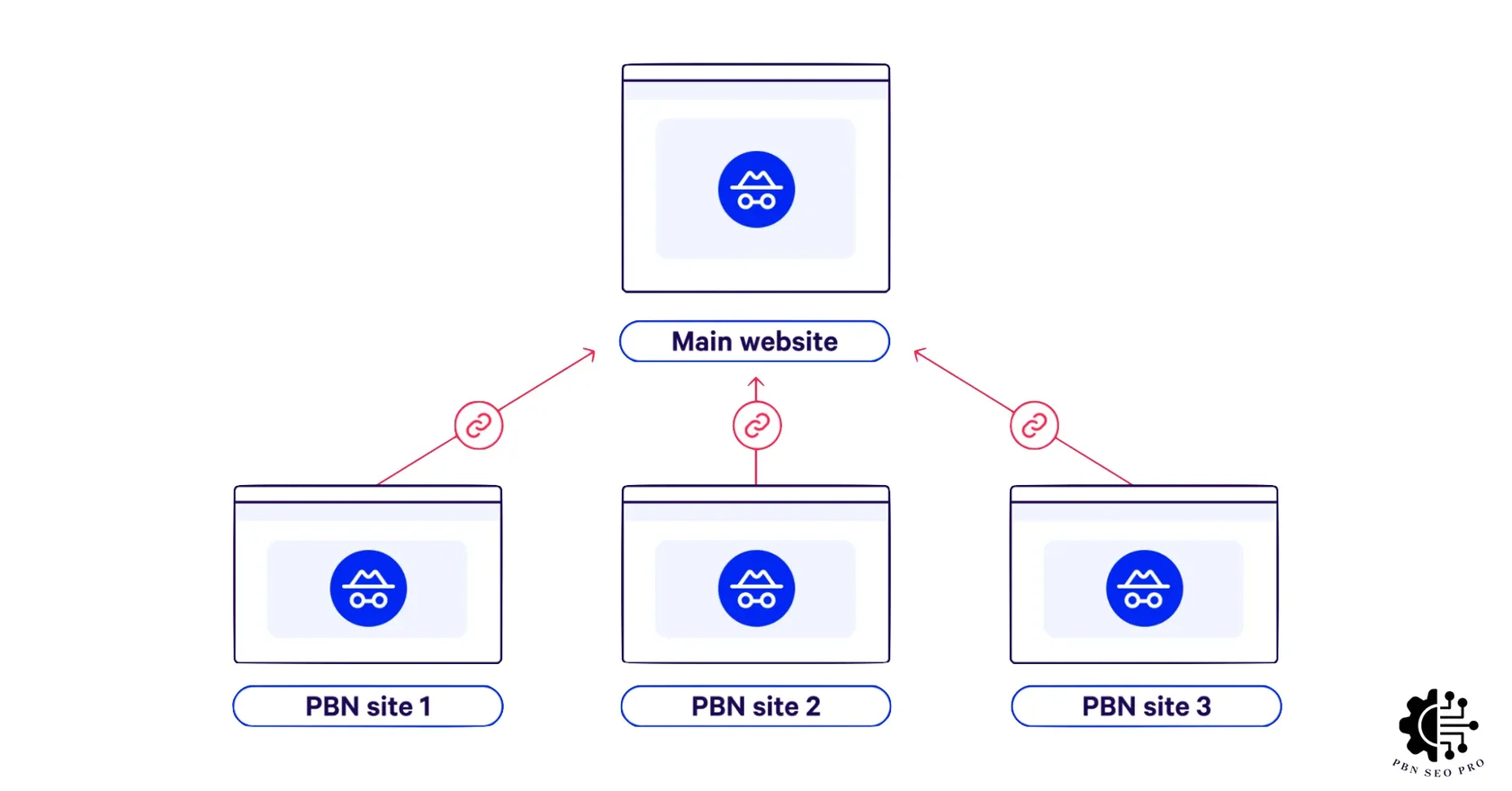
Step-by-Step Workflow
- Buy or create satellite sites — anywhere from 10 to 150+ depending on scale
- Fill them with relevant content to make them look active and legitimate
- Point links from these sites to the main site, controlling anchor text and placement
- Search engines read these as external editorial recommendations
- The main site climbs in search rankings
Key Parameters of a Quality PBN
| Parameter | Requirement |
|---|---|
| Domains | Dropped domains with real backlink history — not just high DR |
| Hosting | Separate providers, separate IPs — nothing shared across sites |
| Content | Unique per site, topically relevant, not obviously generated |
| Relevance | Satellites in the same or related niche as the money site |
| Anchor text | Distributed naturally — branded, naked, partial match, exact — no over-optimization |
| CMS & design | Different themes, plugins, layouts — no consistent fingerprint |
Why Anchor Text Control Matters
Link equity — what SEOs call "link juice" — is the ranking value passed from one page to another through a hyperlink. PBN operators concentrate that value by pointing many domains at the same money page. Over-optimized anchor profiles are a textbook PBN footprint that Google flags reliably.
Of all the rules people ignore most often — it's anchor profiles. They still set 80% exact-match anchors and wonder why the site got filtered. My recommendation: if you're starting a new network, don't use exact-match keywords in anchors for more than 50% of the profile for the first three months. Brand and naked URLs only. Most people push back on that — then come around once they've seen what happens without it.
How PBN Tactics Have Shifted Over Time
| Period | What Changed |
|---|---|
| 2009–2011 | Blog networks ran openly — nobody was hiding much |
| 2012 | Google Penguin launched and hit manipulative link profiles hard |
| 2014 | A number of established PBN providers received public manual penalties from Google |
| 2016–2020 | Networks shifted to distributed hosting, varied CMS setups, and mixed themes to reduce footprint |
| 2022–2024 | AI content made cheap PBN posts trivial to produce — and easier to detect |
| 2025–2026 | SpamBrain models the link graph at scale, flagging coordinated clusters before manual review even happens |
Why People Still Build Them
Full Control Over the Backlink Profile
With outreach you negotiate. With guest posts you wait. With a PBN, you place the link, pick the anchor, and move on. No platform shutdown takes it offline. That kind of control is nearly impossible to replicate with any other link building method.
Fast Results in Competitive Niches
Try getting a natural link to a gambling affiliate site. Most publishers won't touch it. PBNs exist partly because niches like iGaming, finance, and crypto left link builders with no realistic alternative at scale — a new iGaming site without links could wait years to reach the top.
No Dependency on Third Parties
Rented links disappear when you stop paying. Exchange partners go dark. Outreach agencies churn. A PBN doesn't have those failure modes. Your network is an asset that works for years.
The Economics Over Time
Those numbers tell the real story. Over a 2–3 year horizon, a well-maintained PBN pays for itself many times over — especially when you're running multiple projects off the same network.
| Method | Cost per Link | 600 Links / Year |
|---|---|---|
| Outreach / Guest Posts | $200–$500 | $120,000–$300,000 |
| Link Exchange Platforms | $50–$150 | $30,000–$90,000 |
| Own PBN (30 sites) | $5–$20 | $3,000–$12,000 |
That's exactly what the course covers: not just how to build a PBN, but how to run it as a long-term asset that compounds over time.

The Risks — Straight Up
PBNs violate Google's link spam policies. That's not a gray area. Build links to move rankings artificially, and you're in manual action territory — full stop.
| Risk | What It Means in Practice |
|---|---|
| Manual penalty | Google reviewer flags the network; main site loses rankings or gets deindexed |
| Satellite deindexing | Network sites removed from Google's index — along with the link value they passed |
| Rising maintenance costs | Quality control across dozens of sites is not cheap or passive |
| Better detection | 2026 algorithms are better at this than 2020 algorithms were — the trend continues |
| Competitor reports | Someone finds your network and files a spam report — it happens |
A manual penalty isn't a myth. I personally watched three years of work disappear in 48 hours over one obvious mistake: all the network sites were running on the same hosting account. Google reads that instantly. Hosting diversification isn't optional — it's basic hygiene.
Core Rules for Running a PBN
Running a PBN that holds up means treating it as a system — one where every variable is managed deliberately to stay below detection thresholds while keeping link value high.
Types of PBNs
1. Classic PBN on Dropped Domains
The most common approach. Built on purchased expired domains that were previously active and have established authority through existing backlinks. It demands the most work upfront — and tends to produce the strongest results.
2. PBN on Freshly Registered Domains (EMD)
New domains carry no authority and build it over time. A practical option when your project has room to grow slowly and your budget isn't under strain.
3. Web 2.0 PBN
WordPress.com, Blogspot, Medium, Tumblr. Cost is minimal, but Google cracked these patterns years ago. Fine as a secondary layer if you need volume, but not reliable as a primary strategy.
4. PBN on Niche Authority Sites
Real sites with real content and real traffic, purchased or built from scratch. Hardest to detect, highest cost of entry.
5. Hybrid PBN
Drops, purchased authority sites, and Web 2.0 properties combined into one network. Not the cheapest, not the strongest — but the most manageable if you're running multiple projects on one budget.
Where to Find Domains for a PBN
Dropped Domain Auctions
Niche Registrars and Brokers
Minimum Domain Selection Criteria
- DR ≥ 15 (Ahrefs)
- Referring domains ≥ 20
- No links from PBN, spam, or adult sites in the profile
- Relevant topic and no prior penalties
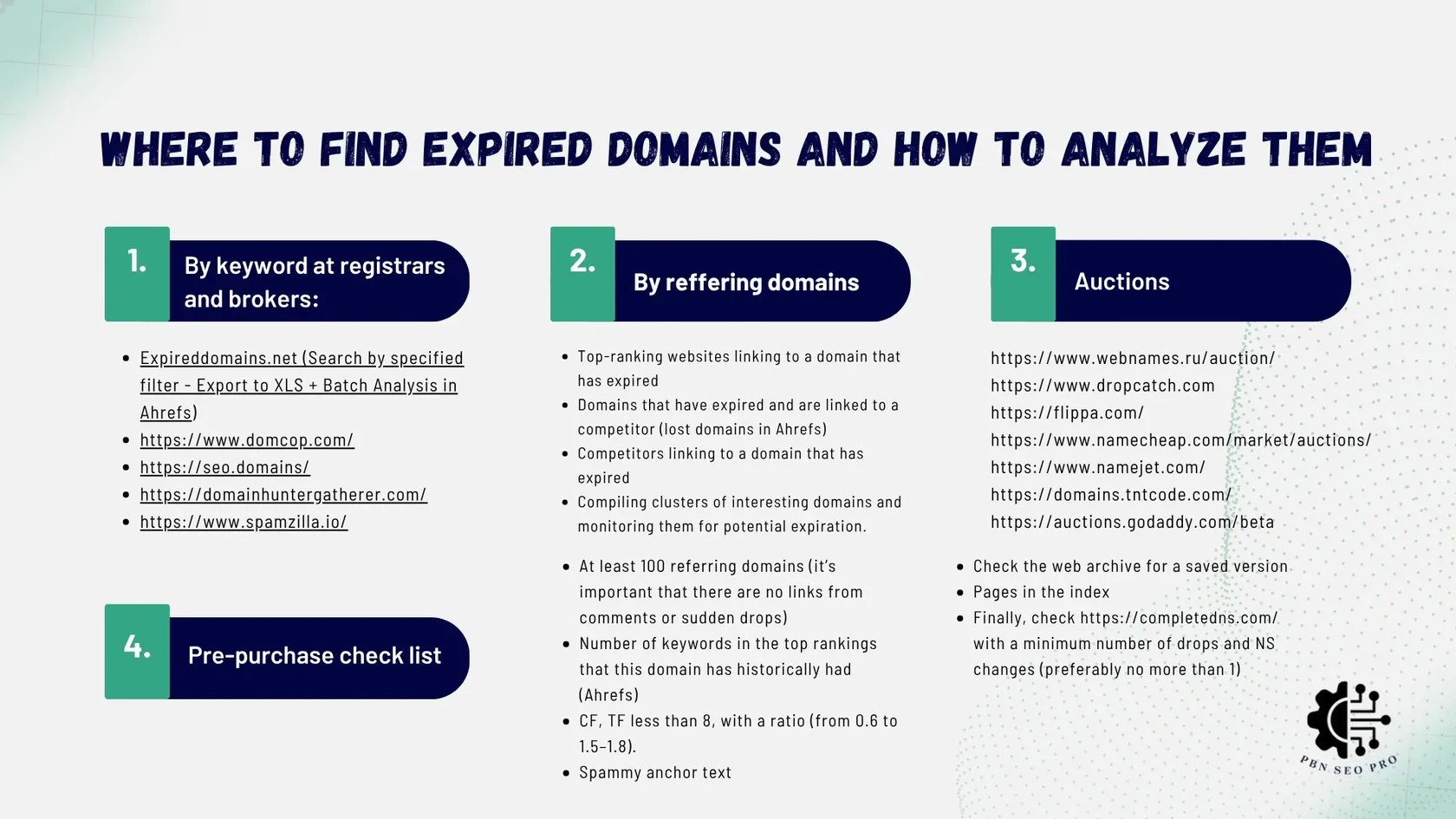
Recovering (Catching) Dropped Domains
Dropped domains retain part of their link profile even after registration expires. A domain with good DR and clean donors gives you ready-made authority without building from scratch.
- Monitor. Keep tabs on what's dropping through ExpiredDomains.net, DomCop, or your preferred monitoring setup.
- Quality check. Pull it in Ahrefs before you put money on it — DR, referring domains, where those links actually come from, any history of manual actions.
- Catch. For valuable domains use SnapNames, DropCatch, NameJet.
- Archive check. Visit web.archive.org to see what the site was before.
What to Do After Selecting Domains
- Register or purchase. Register through different registrars — Namecheap, GoDaddy, Google Domains, Name.com.
- Set up hosting. Own account, dedicated IP, separate provider, separate location — for every site, without exception: Hetzner, DigitalOcean, Vultr, OVH, SiteGround.
- Install CMS. WordPress is most common, but vary versions, themes, and plugin sets. Some sites should run on Joomla, Ghost, or static HTML.
- Publish content. Minimum 10–20 articles before adding any links to the money site.
- Add links. Place gradually — 1–2 new links per month from each satellite. Mix up the anchors.
- Remove your footprint. Block Ahrefs, Semrush, Majestic via robots.txt or .htaccess. Use separate analytics accounts per site.
PBNs in iGaming — A Completely Different Scale
iGaming isn't just competitive — it's a different category entirely. Casinos, bookmakers, affiliate operations — all chasing the same terms, and the ones already on page one have been building their infrastructure for years.
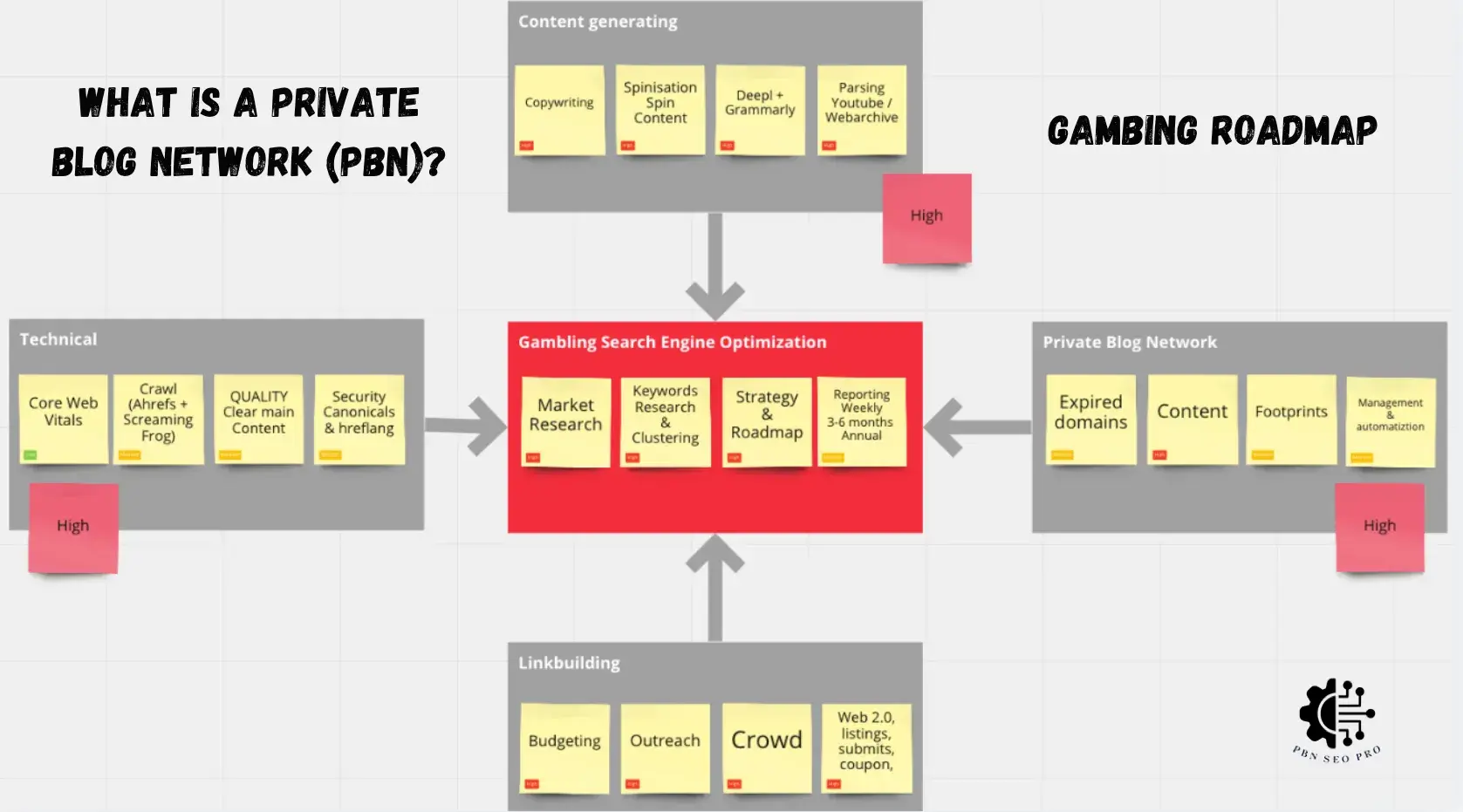
| Factor | iGaming Reality |
|---|---|
| Topic relevance | Satellites must cover gambling, betting, or directly adjacent topics |
| Domain acquisition cost | Aged iGaming domains carry significant premiums |
| Algorithmic scrutiny | Google classifies gambling as YMYL and applies stricter quality signals |
| Link velocity | More aggressive build-out required due to competition levels |
| Content standards | Strong E-E-A-T signals needed — thin content fails fast |
After 15+ years in SEO and hundreds of projects in the iGaming niche, the biggest mistake beginners make is reducing a PBN to a simple formula: "bought domain → placed link." A PBN in 2026 is a complete system with dozens of variables. Treat it carelessly, and it turns against you faster than you'll see any results.
Toxic Backlinks in Your Profile: Diagnosis and Cleanup
Problems almost always come from where you least expect — third-party spam, negative SEO from a competitor, or an automated link blast. Toxic links don't announce themselves — only a consistent audit schedule will surface them before they pull rankings down.
Step 1: Backlink Audit
- Links from completely irrelevant topics or languages
- Sites with suspiciously low traffic and artificial appearance
- Massive link growth over a short, unnatural time period
Step 2: Identify Toxic Domains
| Signal | Toxic Indicator |
|---|---|
| Traffic | Near zero (Ahrefs/Semrush) |
| DR/DA | Artificially inflated vs. real traffic |
| Outbound links | Hundreds of links to unrelated sites |
| Content | Thin, spun, or AI-generated without context |
Step 3: Disavow Toxic Links
Use the Google Disavow Links tool. Compile your list in .txt format and upload via Google Search Console → Disavow Links Tool. Re-crawl typically takes 2–6 weeks.
Step 4: Keep Watching
- Set up weekly alerts for new links in Ahrefs or Semrush — don't wait for a spike to notice something's off
- Monthly review of all new referring domains
- Any unexplained spike gets investigated immediately
Long Story Short
PBN SEO in 2026 isn't a shortcut. It's infrastructure — expensive to build properly, ongoing to maintain, and genuinely damaging when built carelessly. The operators winning with them approach it like an engineering discipline: systematic, documented, and constantly adapted as detection improves.
In iGaming, organic link velocity is near zero, most publishers won't touch gambling content at any price, and the sites already on page one didn't get there by waiting. A well-run PBN is often the gap between ranking and not ranking in this niche.
After 8 years specifically in the iGaming niche, I can say one thing clearly: a PBN is not a strategy for everyone. But for iGaming, crypto, and finance — it's the only realistic way to compete with the big players without their PR and outreach budgets. The question isn't "should I use a PBN" — it's "am I ready to do it right."


