


PBN: Build It Yourself or Hire an Agency - What Makes More Sense in 2026
Here's how most people approach this decision: they spend two weeks comparing hosting providers, reading about expired domains, watching YouTube tutorials about WordPress footprints - and somewhere around week three realize they never answered the only question that mattered from day one. Who's building this?
Two paths. Hire someone, get a network handed over. Or learn the system and build it yourself. I'm not going to tell you one is always right. But after 8 years doing this specifically in iGaming, the math tends to point the same direction for anyone who's serious long-term.
This article doesn't blindly sell either approach. It breaks down what you actually get in each case, what it costs in real numbers, and why for most serious projects the right answer is one.
What "Turnkey PBN" Actually Means
Before comparing, it's important to understand what a turnkey PBN actually includes - because different agencies mean very different things by that term.
A full turnkey PBN covers the entire cycle: finding and vetting domains by SEO metrics, registering on separate registrars, setting up hosting with different IP addresses, installing CMS, publishing topical content, placing links, and basic footprint masking.
Partial service means the agency only provides domains, or only places links on a client's existing network. That format often costs less, but responsibility for quality is distributed differently.
What This Actually Costs
I've watched people budget a DIY build at near zero and then get blindsided once they count the hours. I've also seen operators spend three weeks hunting for a $2,000 version of a $6,000 agency quote - that version doesn't perform the same way. Here's what things actually run in 2025-2026.
DIY Build Costs - 30 Sites
Agency Pricing
Everyone forgets their own time. I've watched people track every hosting invoice to the dollar and never once account for the 100 hours they personally spent on setup. Run that math at even $30 an hour - you're at $3,000 before a single link goes live. One-time cost, though. The agency invoices you every month whether the links are moving rankings or not.
Side by Side: The Full Picture
- Full control over the network
- 100% transparency - you see every domain
- Lower ongoing costs after launch
- An asset that stays with you
- Lower exposure risk
- Unlimited scaling on your terms
- Partial or limited control
- Transparency depends on contractor
- Higher ongoing management costs
- Someone else's infrastructure - not yours
- Contractor knows your network structure
- Scaling limited by contract terms
When Hiring an Agency Makes Sense
Turning to an agency makes sense in specific situations - not because it's easier, but because it's the logical and practical choice.
- You need rankings before the quarter ends. A proper 30-site DIY build takes months done right. An agency with an established process can have links placed in two to four weeks. Sometimes the deadline is the deciding factor.
- You're testing whether the niche works at all. Four months of network building for a project you're not committed to yet is a poor bet. Use someone else's infrastructure to validate first. If it converts, then you build something permanent.
- SEO is one tool among twenty on your plate. If you're running a business and links are not your core focus - outsourcing that piece is focus, not laziness.
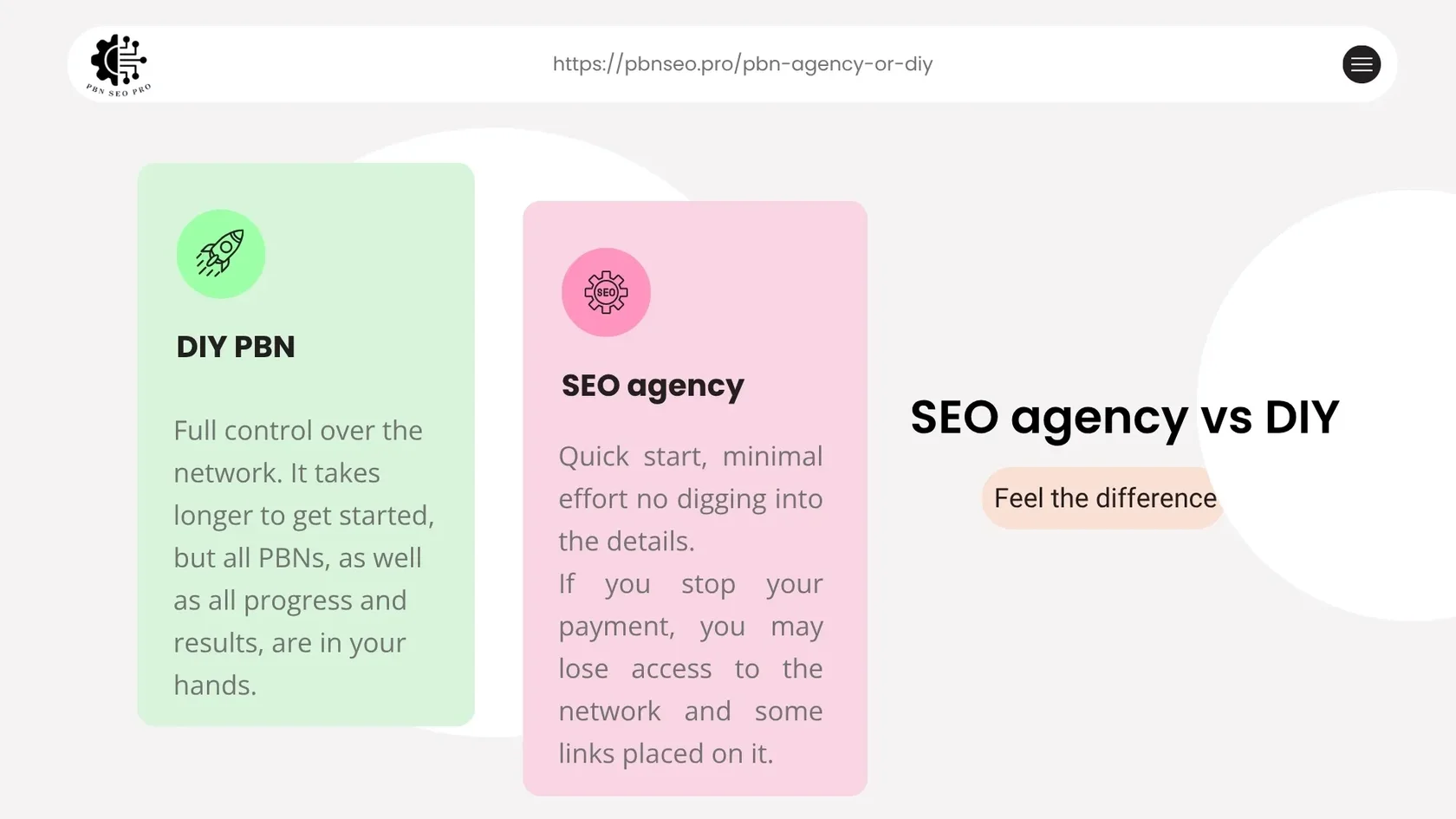
When Building It Yourself Is the Only Answer
Some setups just don't make sense to hand off. Not because agencies are universally bad - some do solid work - but because the economics and risk profile stop working in your favor.
- Managing several projects at once. Price a 40-site network across four properties against buying links independently for each. The per-link math shifts dramatically. It gets better every year both are running.
- iGaming, crypto, finance. YMYL territory. Google looks harder at these niches than almost anything else. Domain vetting here isn't a generalist task - one domain with the wrong redirect history or prior use can introduce a problem into the network that's harder to fix than whatever ranking issue you were solving.
- You're thinking in years, not quarters. Agencies hand over infrastructure. The understanding of that infrastructure stays with them. Something breaks - you call them. They shut down - you start from zero. What you build yourself, you can actually run.
- The contractor knowing your setup bothers you. It probably should, at least a little. They know the money site, the satellite structure, the anchor approach. That's real information sitting outside your control.
Want to learn how to build PBN networks yourself?
From scratch, with real iGaming case studies and without expensive mistakes on live projects
Go to PBNSEO.PRO →The 3-Year Math
Three scenarios, three years. The numbers tell a story that changes how most people think about this decision. The DIY path costs more up front in time, but by year two you're in maintenance mode. The agency path keeps invoicing indefinitely. Outreach links exist only as long as the payments do.
The agency premium over DIY stretched across three years is about $6,200. Not a number that should be making the decision for you. What the math doesn't show is year four. The DIY operator still has the network - and it's better than it was at the start. The agency client either keeps the payments going or loses everything built. The outreach buyer holds zero residual value.
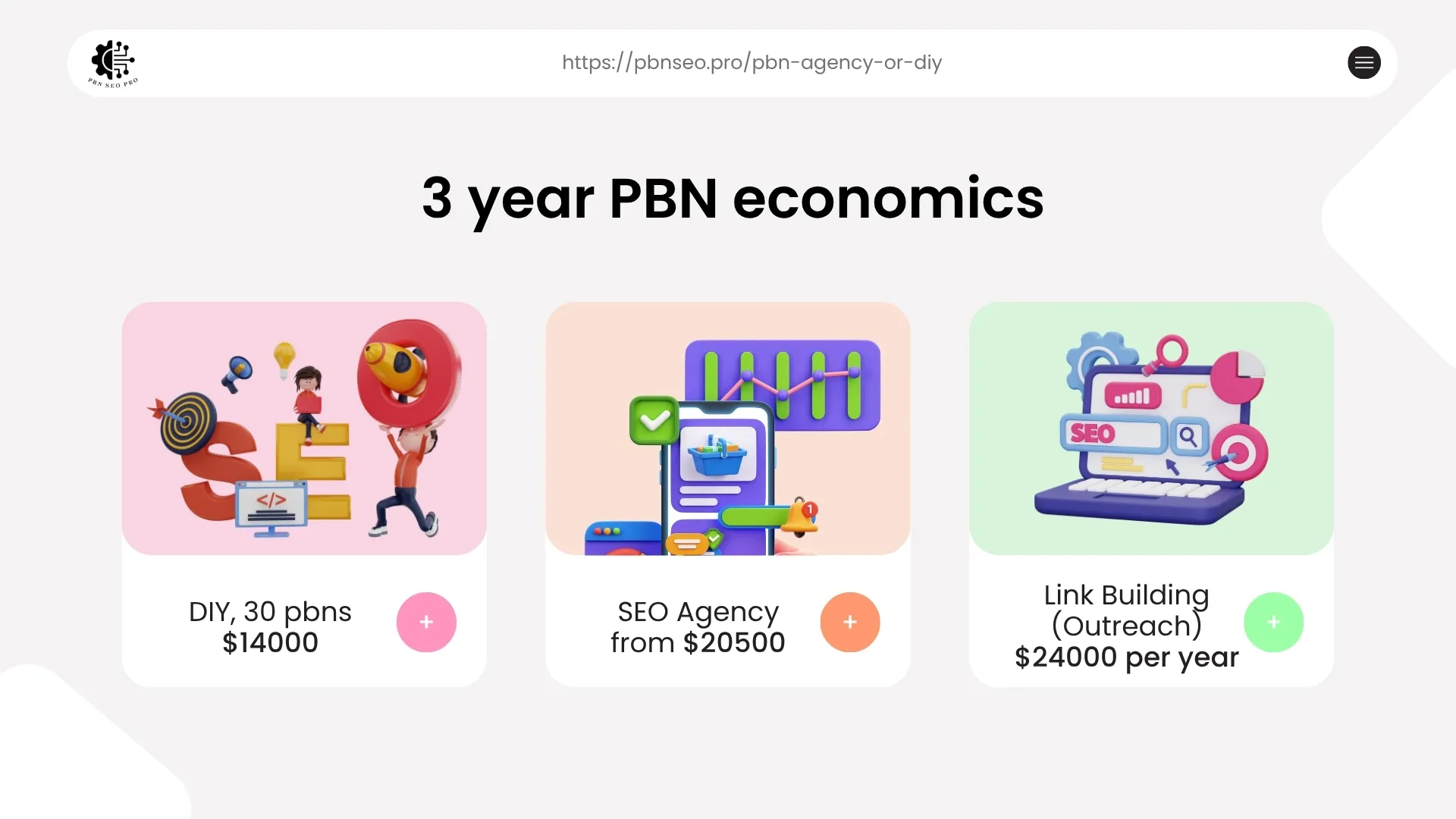
I've had clients come in after two years of outreach at $250k total. Weren't bad at SEO. Just hadn't framed it as capital allocation. A network you build is an asset on your balance sheet. Links you rent are an operating expense with no equity. Most people only see that distinction clearly after the $250k is gone.
Choosing an Agency: 7 Questions That Filter Out the Bad Ones Fast
If an agency is part of the plan - even short-term - here's what to ask before anything gets signed.
- Show me the actual domains. Not metrics screenshots. Not descriptions. Five live domains with their Ahrefs data. If that request gets declined before payment - walk.
- How many different hosting providers are you running? Multiple sites on one server is the most basic footprint error and plenty of agencies still make it. Get a specific answer on IPs and providers.
- Content from live satellite sites - real examples. Not pitch samples. What does a site in their network actually look like six months after launch?
- What's my access level? Admin credentials to every site, or nothing. If they control hosting and CMS with no login for you - you're subscribing to a service, not buying infrastructure.
- Walk through the footprint approach out loud. Different CMS versions, theme variation, analytics separation, how they block crawlers. Agencies who actually know this bring it up without prompting.
- What happens when sites get deindexed? Some will, eventually. An agency worth hiring has a replacement protocol - timeline, trigger, accountability. Any answer involving "that won't happen" is disqualifying.
- iGaming experience - get specifics, not a yes. Ask about YMYL classification and how it affects domain selection. Ask what they filter for in prior redirect history. If it gets vague fast, the answer is no.
Red Flags: When to Walk Away Immediately
- 🚩 Refuses to show domains before payment - hiding quality or reselling someone else's network
- 🚩 Promises guaranteed results - doesn't understand how this works, or is deliberately misleading
- 🚩 All sites on the same hosting - basic error that will cost you dearly
- 🚩 No admin access to sites - you're renting, not buying
- 🚩 Can't show content examples - thin AI content or mass-generated articles
- 🚩 Pricing significantly below market - something was cut that shouldn't have been
Learning DIY Without Paying for Mistakes You Could Have Avoided
The learning curve is real. First few domains in any DIY build almost always have something off - metrics that looked fine, history that only becomes a problem after you've seen a hundred profiles. First hosting setup usually has at least one shared IP. First anchor plan almost always skews too hard toward exact match.
None of that is unusual. The problem is what those early mistakes cost in the iGaming context specifically. A footprint issue that causes a minor ranking drop on a general content site can mean a manual action and a long recovery on a gambling affiliate. That asymmetry is brutal and most people only understand it after it happens.
That's the specific problem the course at PBNSEO.PRO was built around - not theory about algorithm mechanics. A practical system from hundreds of actual iGaming and affiliate projects.
Quick Reference: Everything at a Glance
| Category | Details |
|---|---|
| Course Modules | |
| Domain Sourcing & Vetting | What actually matters in metrics vs. what just sounds good |
| Hosting Architecture | Specific providers, IP setup, real geographic diversification |
| CMS & Footprint Reduction | What to vary, how much is enough, where people get sloppy |
| Content for PBN Satellites | Volume, format, AI usage without creating detection signals |
| Anchor Planning (iGaming) | Distribution, velocity, rotation with real iGaming examples |
| Technical Masking | robots.txt & .htaccess configs, analytics separation, crawler blocking |
| Link Deployment | Which pages, what timing, how to read early signals |
| Case Study Breakdowns | What worked, what got penalized, and why |
| ✅ Good Fit | |
| SEO Professional | Adding PBN as a real capability to your skill set |
| iGaming / Finance / Crypto Operator | Ready to build your own infrastructure |
| Affiliate Marketer | Wants full control over your link profile |
| Agency | Wanting to offer PBN as a service you actually understand |
| 🚫 Not a Fit | |
| Passive learner | Wants results without real time investment |
| Quick-fix seeker | Looking for a one-afternoon setup |
What I've watched happen repeatedly: someone spends $15,000-$30,000 building a network through an agency or following tutorials, it gets flagged, they lose the rankings they paid for, and then they come looking for answers. The information that would have prevented that isn't complicated - it's specific, and it's not written down anywhere in one place. That's what the course is. Not a guarantee. A map from someone who already made the expensive wrong turns.
FAQ
Long Story Short
An agency gives you a network. Doesn't give you the knowledge to run one. Without that, you're dependent on them for as long as you use them. Contract ends, they cut corners, they shut down - any of those things happen and you're back at zero.
Your own expertise doesn't work that way. It compounds. Every project, every adjustment, every anchor plan you revise based on real data - that stays with you. The network you build in year one is worse than the one you build in year three. That progression only happens if you're the one building it.
In iGaming, the operators holding the top positions and the ones stuck just off the first page are often separated by one thing: who owns the infrastructure. Not a budget gap. A knowledge and control gap. Closeable - just requires the decision to close it.
Eight years in this niche. The people who build something that actually holds - not just ranks for a quarter, but grows - almost all of them hit a point where they decided to understand this from the inside. The course is built for that moment.

